Would you like to switch to the accessible version of this site?

Go to accessible site Close modal window

Don't need the accessible version of this site?

Hide the accessibility button Close modal window
Accessibility View Close toolbar

(775) 825-7984

Open mobile navigation
  • Home
  • About Us
    • Meet The Team
    • Virtual Office Tour
    • Pet Memorials
  • New Patient Center
    • Online Forms
    • Payment Options
    • Veterinary Resources
  • Services
    • Rx Home Delivery
    • Dentistry
    • Ultrasound
    • Laser Therapy
    • Cancer Treatment
    • Geriatric/Hospice Care
    • Online Medical Records
    • Veterinary Topics
    • Pet Selector
  • Contact Us
    • Emergencies
    • Schedule an Appointment
  • Schedule Appointment
  • Galleries
  • Petsimonials
  • Links
  • Careers
  • Blog
  • Home >
  • Articles >
  • Feline >
  • Living With Your Pet >
  • Providing Care >
  • Anesthesia

Anesthesia

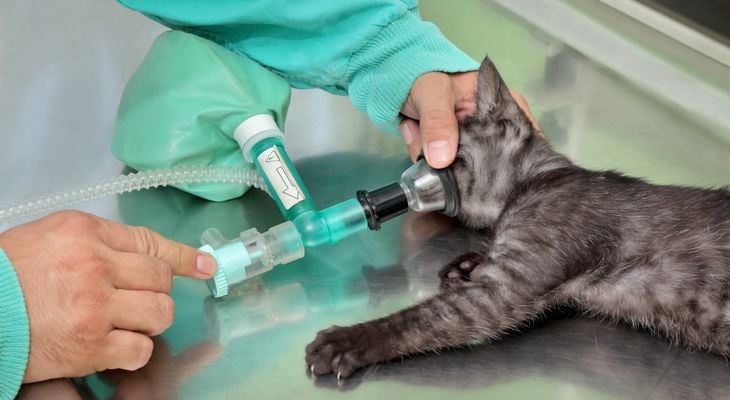
cat getting anesthesia
It’s an unfortunate fact that most cats don’t relish a trip to the vet. For this reason, sometimes they need to be sedated—both for their own and the veterinarian’s safety—during even relatively simple procedures. Anything from dental care to a major surgery may require anesthesia. Some especially high-strung cats even need to be unconscious for standard, noninvasive procedures, such as changing bandages or examining ears.

Anesthetic agents may be injected under the skin, inhaled or administered intravenously. Some are local—anesthetizing only a limited area—while others render the cat unconscious. Your feline veterinarian will recommend the type of anesthesia that is appropriate, depending on the procedure and your cat’s personality.

Local Anesthesia

Just like in people, local anesthesia blocks pathways between the anesthetized area and the brain, so the patient feels no pain. Your vet may apply local anesthesia topically, in the case of a wound, or inject the agent into the area to be treated. This procedure usually starts with a mild, calming sedative. Suturing, cleaning wounds and removing small tumors are examples of procedures requiring injectable local anesthesia. Depending on the medication used, effects typically last 10-30 minutes. Since cats are very sensitive to anesthesia, your vet will try to use the lowest dose possible.

General Anesthesia

For general anesthesia, the vet first injects the cat with a sedative and then follows this up with a drug that causes a deep sleep. The vet inserts a tube into the cat’s trachea so that it will still receive enough oxygen while unconscious. The cat inhales anesthetic gas throughout the procedure. The veterinary staff constantly monitors the cat’s heart rate, pulse, mucus membrane color, jaw tone and reflexes. Pulse oximeters, which measure the blood’s oxygen content, are also commonly used.

The staff also monitors the cat post-operation. Usually the cat is back to normal within an hour. However, sometimes the veterinary hospital will want to keep a patient overnight for further observation and care.

Vets and Anesthesia

All licensed veterinarians are trained to safely administer anesthesia. In smaller practices, the veterinarian and his or her staff monitor the cat’s stability while under anesthesia. In larger veterinary hospitals, an anesthesia specialist may be on staff to oversee all anesthesia issues.

Safety

While anesthesia is generally safe for humans and cats, there are some rare cases where the patient dies from anesthesia or a related complication. This is more common for cats than for dogs. According to a study published on the NIH website, about one in 895 healthy cats die in an anesthesia-related incident. Risk factors include advanced age and being overweight. Monitoring with a pulse oximeter may decrease these risks.

Many pet cats will require anesthesia sometime in their lives. Call us today to discuss your concerns about your cat’s care, including issues related to anesthesia. We’ll be happy to find the safest way to treat your cat’s health problems.

No article settings found. Please configure it

Featured Services

  • Online Forms

    Our patient forms are available online so they can be completed in the convenience of your own home or office.
  • Services

    We strive to provide complete care for our patients. Learn more about all the services we provide.

Office Hours

Monday:

7:30 AM-5:30 PM

Tuesday:

7:30 AM-5:30 PM

Wednesday:

7:30 AM-5:30 PM

Thursday:

7:30 AM-5:30 PM

Friday:

7:30 AM-5:30 PM

Saturday:

Closed

Sunday:

Closed

Find Us

Check out the map below to locate SWVH!

Testimonials

We love to hear your feedback!

  • "Southwest Vet is a wonderful place to take our animals. The front desk ladies are knowledgeable, patient, and compassionate. The vet techs are so wonderful with our animals. And Drs. Sargent and Rasmussen are just the tops!! The care our animals receive is extraordinary!!"
    Sarah S.
  • "Thank you so much for all that you do. You have always gone above and beyond for my pets and I. I feel truly blessed to have found you when I moved to Reno. Tank thinks you’re pretty awesome, too!"
    Ashley D.
  • "Thank you to each and every one of you who helped care for Gus while he was recovering during his long and scary week with Parvo. We can’t thank you enough for everything you did to get our loving and playful guy home."
    Aaron and Lisa C.
  • "So rare it seems to encounter an entire professional office who are as smart as they are kind. We are so grateful to have you care for Einstein. Thank you for your excellent care, patience and generosity."
    Leah R.

Featured Services

  • March Newsletter: How to Keep Your Cat Safe When Outdoors

    Wondering how your cat can safely spend time outdoors? ...

    Read More
  • March Newsletter: How to Choose Safe Blankets for Pets

    Do you know how to pick a safe blanket for your pet? ...

    Read More
  • February Newsletter: How to Reduce Dental Anxiety in Pets

    Does your pet hate toothbrushing? These tips could reduce dental anxiety. ...

    Read More
  • February Newsletter: How to Safely Change Your Cat’s Food

    Buying a new food for your cat? Find out how to switch foods safely. ...

    Read More
  • January Newsletter: Signs Your Pet Needs a Wellness Exam

    Does your pet need a wellness exam? ...

    Read More
  • January Newsletter: How Your Veterinarian Can Help If Your Pet Ingests Something Toxic

    Has your pet eaten something it shouldn't have? Find out how your vet can help. ...

    Read More

Newsletter Sign Up

Error!

    • Copyright © 2026 MH Sub I, LLC dba iMatrix.
    • Admin Log In
    • Site Map