Would you like to switch to the accessible version of this site?

Go to accessible site Close modal window

Don't need the accessible version of this site?

Hide the accessibility button Close modal window
Accessibility View Close toolbar

(775) 825-7984

Open mobile navigation
  • Home
  • About Us
    • Meet The Team
    • Virtual Office Tour
    • Pet Memorials
  • New Patient Center
    • Online Forms
    • Payment Options
    • Veterinary Resources
  • Services
    • Rx Home Delivery
    • Dentistry
    • Ultrasound
    • Laser Therapy
    • Cancer Treatment
    • Geriatric/Hospice Care
    • Online Medical Records
    • Veterinary Topics
    • Pet Selector
  • Contact Us
    • Emergencies
    • Schedule an Appointment
  • Schedule Appointment
  • Galleries
  • Petsimonials
  • Links
  • Careers
  • Blog
  • Home >
  • Articles >
  • Feline >
  • Living With Your Pet >
  • Providing Care >
  • Cats and Poisons

Cats and Poisons

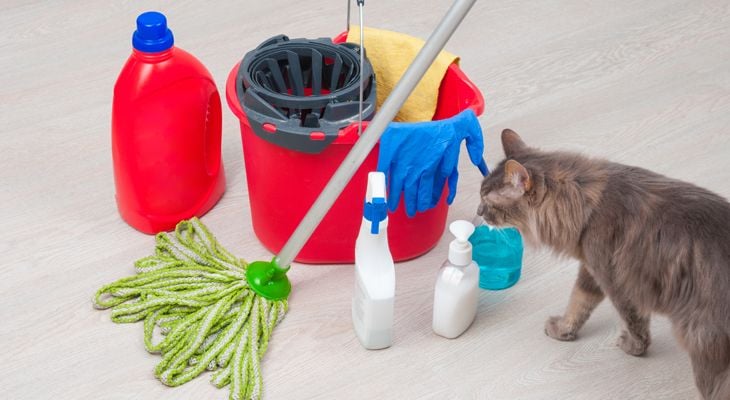
cat with cleaning supplies
Many cat owners already know that insecticides and antifreeze are not things their cats should consume. However, many everyday, innocuous-seeming substances are also poisonous to cats. From a beautiful bouquet of lilies to human medications casually left around the house, you never know what you cat might get into. That’s why it is best to educate yourself before disaster strikes.

Signs of Poisoning

If your cat consumes the wrong thing, you will see a sudden onslaught of symptoms. They may include:

  • Diarrhea
  • Vomiting
  • Dilated pupils
  • Disorientation
  • Staggering
  • Breathing troubles
  • Coughing
  • Drooling
  • Shivering, tremors or seizures
  • Sudden weakness

What’s Poisonous?

Here are a few things that may be poisonous to your cat.

Indoor and Outdoor Plants

Yard landscapes, houseplants and bouquets all can contain beautiful hazards for your cat. Lilies are especially poisonous to cats, and are very common in bouquets, especially around Easter. Chrysanthemums and tulips are also better left outside. Poinsettias, mistletoe, azaleas and marijuana can all harm your cat as well.

Human Medicines

Of course you do not want your cat to take any prescriptions meant for humans. Nonetheless, even over-the-counter drugs and supplements, such as pain relievers, cold medicines and vitamins, can poison felines. Always talk to your vet before administering any medication to your cat.

Common Foods

Many foods that are healthful for humans are harmful to cats. These include chocolate, garlic, onions, grapes, raisins, chives and yeast dough. Nor should you serve your cat coffee or alcoholic drinks. Xylitol, a common ingredient in sugarless candies, gum and toothpaste, is also a no-no.

Chemicals

Bleach, fertilizers and detergents are obviously contraindicated, but you might be surprised at how good they taste to cats. Lock these chemicals away. Remember, cats are dedicated to hygiene. They can accidentally ingest poisons while cleaning their paws.

Permethrin Poisoning

Many cats are poisoned by well-meaning owners who use flea medicines designed for dogs on their cats. According to the ASPCA Animal Poison Control Center, ingesting the ingredient permethrin accounts for a large percentage of feline toxicities. Cats may also be poisoned by indirect exposure, such as grooming a dog friend after the dog’s been treated with flea medication.

Treatment

If you act quickly, you have a better chance of saving your poisoned cat. Call your vet or the Animal Poison Control Center at (888) 426-4435 immediately. It’s a good idea to keep these numbers on your fridge or a bulletin board, so you can easily access them in emergencies.

If your cat has ingested a poisonous agent, and you are able to take him or her to your vet, your vet will probably ask you to collect samples of vomit or stool. Take those and the poison to the vet (along with your cat). Depending on the poisonous agent, your vet might induce vomiting, administer activated charcoal to soak up any remaining poison or start fluid therapy to control the level of acid in the blood. Muscle relaxants or anti-seizure medications might be necessary if the cat is having muscle tremors or seizures.

If you think your cat has consumed poison, call our office or the Animal Poison Control Center immediately. There’s no time to waste.

No article settings found. Please configure it

Featured Services

  • Online Forms

    Our patient forms are available online so they can be completed in the convenience of your own home or office.
  • Services

    We strive to provide complete care for our patients. Learn more about all the services we provide.

Office Hours

Monday:

7:30 AM-5:30 PM

Tuesday:

7:30 AM-5:30 PM

Wednesday:

7:30 AM-5:30 PM

Thursday:

7:30 AM-5:30 PM

Friday:

7:30 AM-5:30 PM

Saturday:

Closed

Sunday:

Closed

Find Us

Check out the map below to locate SWVH!

Testimonials

We love to hear your feedback!

  • "Southwest Vet is a wonderful place to take our animals. The front desk ladies are knowledgeable, patient, and compassionate. The vet techs are so wonderful with our animals. And Drs. Sargent and Rasmussen are just the tops!! The care our animals receive is extraordinary!!"
    Sarah S.
  • "Thank you so much for all that you do. You have always gone above and beyond for my pets and I. I feel truly blessed to have found you when I moved to Reno. Tank thinks you’re pretty awesome, too!"
    Ashley D.
  • "Thank you to each and every one of you who helped care for Gus while he was recovering during his long and scary week with Parvo. We can’t thank you enough for everything you did to get our loving and playful guy home."
    Aaron and Lisa C.
  • "So rare it seems to encounter an entire professional office who are as smart as they are kind. We are so grateful to have you care for Einstein. Thank you for your excellent care, patience and generosity."
    Leah R.

Featured Services

  • March Newsletter: How to Keep Your Cat Safe When Outdoors

    Wondering how your cat can safely spend time outdoors? ...

    Read More
  • March Newsletter: How to Choose Safe Blankets for Pets

    Do you know how to pick a safe blanket for your pet? ...

    Read More
  • February Newsletter: How to Reduce Dental Anxiety in Pets

    Does your pet hate toothbrushing? These tips could reduce dental anxiety. ...

    Read More
  • February Newsletter: How to Safely Change Your Cat’s Food

    Buying a new food for your cat? Find out how to switch foods safely. ...

    Read More
  • January Newsletter: Signs Your Pet Needs a Wellness Exam

    Does your pet need a wellness exam? ...

    Read More
  • January Newsletter: How Your Veterinarian Can Help If Your Pet Ingests Something Toxic

    Has your pet eaten something it shouldn't have? Find out how your vet can help. ...

    Read More

Newsletter Sign Up

Error!

    • Copyright © 2026 MH Sub I, LLC dba iMatrix.
    • Admin Log In
    • Site Map